Email: tea.alagic@mac.com
Phone: 917 539 3928
Address:
1919 Madison Avenue, Apt 309 New York, NY 10025
Kafka Amerika
1997
Based on the Unfinished Novel by Franz Kafka
Conceived, Directed, and Designed by Patrick Kealey and Bruno Santini
Group K, 1997 Southwark Playhouse, London
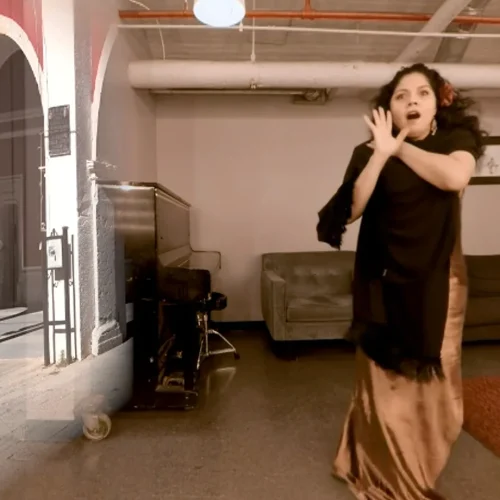
Featuring Tea Alagić as Johanna, Teresa, and Angel
About the play:
Amerika was written between 1912 and 1913 by Franz Kafka. Although never completed, Kafka tin-kered with it happily ever after. At one point it was to be called The Man Who Disappeared. Kafka’s tone is playful and fun at the expense of his hapless young hero Karl Rossman, who is proje-cted into a frenzied, chaotic, and alarming New World, which we then encounter through his eyes.
It is a comic odyssey, which places Karl in a classic Kafka set-up: he exists as an alien despe-rately trying to integrate and ingratiate himself into a system whose rules of conduct are unfamiliar to him. As fantastic as this may seem, however, Karl’s journey would have been a recognisable problem to the millions of Europeans funnelled through Ellis Island to New York in the nineteenth and early twentieth century, an experience that must frequently have been stressful and disquieting.
TEA ALAGIĆ STUDIO
REVIEWS / PRESS
Time Out London 1997
America by Patric Marmion
‘Amerika’
Southwark Playhouse (Fringe)
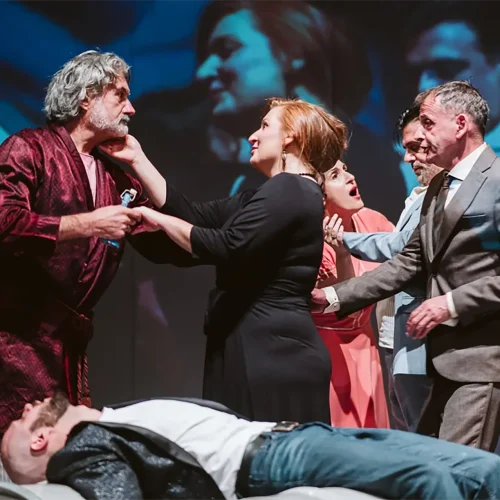
‘Amerika’ is comfortably Kafka’s most visionary novel and Group K have succeeded in translating the book into an equally magical stage version. This is the tale of young Karl Rossmann banished to America by his father after getting a servant girl pregnant. Alone in New York (bar his mysterious uncle) all that remains of his life in Europe is a box of family mementos. Slowly shorn of these mementos, he is sucked into a world of venality, seduction, petty regimentation, yodelling divas receiving cunnilingus and the mandatory Kafka encounter with The Law. But just when it seems the game is up, Karl discovers The Nature Theatre of Oklahoma and is whisked away into the light and space of the American landscape in an exquisite parable of last minute redemption.
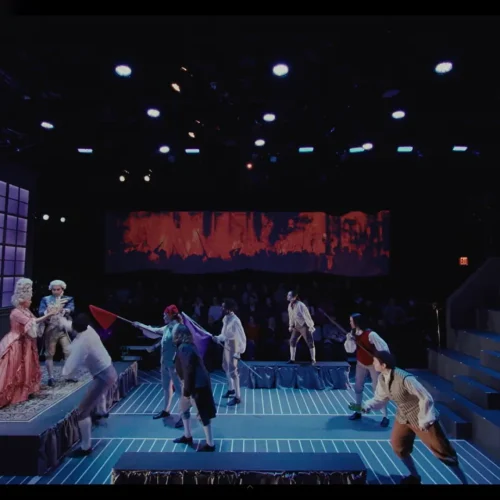
With an 11-strong squad this is total theatre, as Group K deploy a bold mixture of physical performance and German expressionism. Even under a rigid monochrome scaffolding structure they create a kaleidoscopic world which radiates colour. On top of this, the remarkable level of visual and aural invention masterminded by Patrick Kealey and Bruno Santini sees such delightful devices as Karl’s box represented as a mobile toilet bowl. Then there are the metamorphic performances, all of which rival the standards set by Theatre de Complicite without being stylistically derivative.
Perhaps the vigorous and pacey script developed by the company with Rob van Sickle could do with standing still more often to explore the mind of its leading character. Perhaps also there is a tendency to usurp Kafka’s spiritual angst with a more contemporary eroticism, but this is no bad thing and passes the ultimate test of rendering the redemptive finale genuinely moving. Patrick Marmion